Best Backend for Flutter: Which Cloud Services Actually Work in 2026?
Firebase vs Supabase vs AWS Amplify: A practical guide to choosing the right backend for your Flutter app without the hype or surprises.
Best Backend for Flutter: Which Cloud Services Actually Work in 2026?
You've built a gorgeous Flutter app. Buttery smooth animations, pixel-perfect UI, the whole nine yards. Now you need a backend.
So you Google "best backend for Flutter", and suddenly you're drowning in Reddit threads, YouTube tutorials from 2022, and someone insisting you should just build your own GraphQL server from scratch.
Cool. Super helpful.
Here's the thing: your backend choice isn't just a technical decision. Pick wrong, and you're looking at unpredictable bills, scaling nightmares, and integration hell that'll make you question your life choices.
Let's cut through the noise and talk about which cloud services actually work with Flutter in 2026 and which ones will drive you crazy.
Why Your Flutter Backend Choice Actually Matters
Before we dive into specific platforms, let's get real about what's at stake here.
Your backend isn't just where data lives. It's the difference between an app that scales smoothly and one that crashes when you hit 10,000 users. It's the gap between predictable monthly costs and surprise $2,000 bills that makes your CFO cry.
What your Flutter app actually needs from a backend:
Real-time data sync that doesn't lag. Authentication that doesn't suck. File storage for images and videos. Serverless functions when you need custom logic. And most importantly? A Flutter SDK that doesn't make you want to throw your laptop out the window.
The wrong backend means you're spending more time wrestling with infrastructure than building features. And nobody got into Flutter development to become a DevOps expert.
Firebase: The Default Choice (For Better or Worse)
Let's start with the obvious one.
Firebase is like that restaurant everyone recommends because it's on every corner. It's convenient, it works, and Google built it specifically for mobile developers. There's a reason most Flutter tutorials start with Firebase.
Why developers love Firebase:
The Flutter integration is seamless. Seriously, you can have authentication working in 15 minutes. The real-time database updates are instant. Cloud storage just works. And when you're building an MVP, nothing beats Firebase for speed.
Plus, the documentation is everywhere. Stack Overflow has answers to basically every Firebase + Flutter question you'll ever have.
Where Firebase falls apart:
NoSQL can become a nightmare when your data relationships get complex. Need to join three collections? Hope you like writing client side logic. Pricing is pay per operation, which sounds fine until you realize your app is making millions of database reads per month. That social media feature you added? Yeah, it just tripled your bill.
One developer on Reddit shared how their Firebase costs jumped 400% when their user base doubled. That's not linear scaling, that's a pricing surprise nobody wants.
And let's talk about vendor lock-in. Moving off Firebase once you're invested? Good luck with that migration.
Real world pricing scenario:
A Flutter app with 50,000 monthly active users doing moderate database operations might run you $100 to $300 per month on Firebase. Sounds reasonable until usage spikes and suddenly you're at $800 without warning.
Supabase: The Open Source Alternative Everyone's Talking About
If Firebase is the popular restaurant chain, Supabase is the hip new spot that just opened downtown.
Supabase burst onto the scene as "the open source Firebase alternative," and developers are genuinely excited about it. Built on PostgreSQL, it brings SQL sanity back to backend development.
Why Supabase is winning developers over:
PostgreSQL means actual SQL queries. Foreign keys. Joins that don't require mental gymnastics. If you've ever tried to model relational data in Firebase's NoSQL, you know exactly why this matters.
The pricing is transparent and predictable. No surprise bills. The free tier is genuinely generous with 100,000 monthly active users compared to Firebase's 50,000. And because it's open source, you can self-host if you want complete control.
The Supabase vs Firebase pricing breakdown:
Supabase starts at $25 per month for their Pro plan with predictable costs. Firebase's pay per operation model can get expensive fast. For an app with 100,000 users doing regular operations, you're looking at roughly $25 to $50 per month on Supabase versus $100+ on Firebase with potential spikes.
That's not just savings, that's budget predictability.
The catch with Supabase:
It's younger. The ecosystem isn't as mature as Firebase. Fewer third party integrations. Less Stack Overflow answers. And while the core features are solid, some nice to haves that Firebase has baked in require more manual setup on Supabase.
Real-time subscriptions work great, but they're implemented differently than Firebase. If you're migrating from Firebase, expect some learning curve.
The Flutter Backend Integration Reality Check
Let's talk about what actually matters when you're coding.
Firebase Flutter integration:
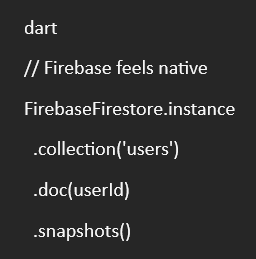
It's intuitive. The packages are well maintained. FlutterFire is officially supported by both Google teams.
Supabase Flutter integration:

The Supabase Flutter client is solid. Not quite as polished as Firebase, but it's getting there fast. And when you need complex queries, SQL just makes more sense.
Both work well with Flutter. The real difference is how you think about your data structure.
AWS Amplify: When You Need Enterprise Power (And Complexity)
AWS Amplify is the heavyweight option. If Firebase is a motorcycle and Supabase is a sports car, Amplify is a semi truck.
When Amplify makes sense:
You're building enterprise software. You need AWS services integration. Your backend requirements are complex and you have a team that knows AWS. Compliance and security certifications matter for your industry.
Why most Flutter developers skip it:
The learning curve is steep. Setup takes days, not hours. The Flutter support exists but isn't as smooth as Firebase or Supabase. And unless you're already deep in the AWS ecosystem, you're probably overcomplicating your life.
For most Flutter apps? Amplify is overkill.
Cloud Storage for Flutter: The Quick Comparison
Storage is one of those things that sounds simple until you're actually doing it.
Firebase Storage:
Easy integration. Generous free tier. Upload resumption built in. Works seamlessly with Firebase Authentication. Pricing is $0.026 per GB stored and $0.12 per GB downloaded.
Supabase Storage:
PostgreSQL backed. Built in image transformations. Row level security policies. Pricing is $0.021 per GB stored and $0.09 per GB egress. Slightly cheaper and more flexible for complex access rules.
Going direct to S3 or Google Cloud Storage:
More control, more complexity. Better for high volume applications or if you need specific CDN configurations. But for most Flutter apps, the integrated solutions from Firebase or Supabase are simpler and just as effective.
When BaaS Isn't Enough: The Custom Backend Route
Here's the truth nobody wants to hear: Sometimes off the shelf solutions don't cut it.
You need a custom backend when:
Your business logic is genuinely complex. You're integrating with existing enterprise systems. You need specific compliance requirements that BaaS platforms don't handle. Multiple platforms beyond mobile need the same backend. Performance optimization requires custom infrastructure.
This is where Voxturr comes in.
VoxturrLabs specializes in building custom Flutter backend solutions for companies that have outgrown BaaS platforms. We're talking custom APIs, complex ERP integrations, multi-tenant architectures, and business logic that can't be shoehorned into Firebase Cloud Functions.
If your Flutter app needs to talk to SAP, handle complex pricing engines, or manage workflows that don't fit the BaaS mold, a custom backend isn't a luxury. It's a requirement.
And unlike starting from scratch, Voxturr builds backends optimized specifically for Flutter integration, so you get the benefits of custom development without reinventing every wheel.
Making the Actual Decision: Your Framework
Stop overthinking this. Here's your decision tree:
Building an MVP or early stage startup?
Go with Firebase or Supabase. Firebase if you want the fastest path to market and don't mind the learning curve later. Supabase if you prefer SQL and want predictable pricing from day one.
Growing product with increasing complexity?
Supabase becomes more attractive as your data relationships grow. The SQL capabilities scale better than NoSQL for most use cases. If you're already on Firebase and hitting pain points, it's worth evaluating Supabase for new features.
Enterprise or highly specialised needs?
Consider AWS Amplify if you're already in AWS. But honestly? Most enterprise apps are better served with a custom backend from a partner like Voxturr. The control, customization, and integration capabilities are worth the investment.
Need multiple client platforms beyond mobile?
Custom backend. Full stop. BaaS platforms are optimized for mobile. If you're building web, desktop, and mobile clients that all need the same backend, don't force fit a mobile first solution.
Getting Started the Right Way
Whatever you choose, start small and validate before you commit.
Pick one feature, build it end to end. Don't try to migrate your entire app at once. Take authentication, or one data model, and implement it completely. Test it. Make sure it feels right.
Watch for these common Flutter backend integration mistakes:
Not handling offline states properly. Flutter apps work offline and your backend integration should too. Over fetching data because you didn't think about mobile bandwidth. Ignoring security rules until you're ready to launch (bad idea). Not planning for migration if you pick wrong.
Test before you fully commit. Most platforms have generous free tiers. Actually build something with them before you make long term architectural decisions. The time you spend experimenting now will save you months of pain later.
The Bottom Line: The Best Backend for Flutter
There's no universal "best" backend for Flutter. Anyone who tells you otherwise is selling something.
Firebase dominates because it's fast to implement and Google backed. But Supabase is rapidly gaining ground with better pricing and SQL sanity. AWS Amplify exists for enterprise needs. And custom backends from partners like Voxturr solve problems that BaaS platforms can't touch.
Your choice depends on your specific situation: team skills, budget constraints, scalability needs, and how complex your data relationships are.
Start with Firebase or Supabase for most projects. Evaluate as you grow. Don't be afraid to migrate if your needs change, just plan for it from the beginning.
And if you're building something genuinely complex with enterprise integrations or unique requirements? Talk to experts who specialize in custom Flutter backends. Your future self will thank you.
Your Flutter app deserves a backend that scales with you, not against you. Whether that's Firebase, Supabase, or a custom solution built by Voxturr, make sure it actually fits your needs, not just what's trending on Twitter this week.
Ready to build a Flutter backend that actually works for your business? Talk to the Voxturr team about custom backend solutions designed specifically for your Flutter app's unique requirements.
Frequently Asked Questions
Q1: What is the best backend for Flutter in 2026?
For most developers, it's either Firebase (fastest to market, great mobile integration) or Supabase (better pricing, SQL database). Firebase wins on maturity and ecosystem. Supabase wins on transparency and cost predictability. Choose based on whether you prefer NoSQL flexibility or SQL structure.
Q2: Is Supabase really cheaper than Firebase?
Yes, typically. Supabase uses predictable tier pricing ($25 per month for Pro), while Firebase charges per operation. For apps with high database activity, Supabase can be 40 to 60% cheaper. But Firebase's free tier is more feature rich for tiny projects.
Q3: Can I use multiple cloud services with Flutter?
Absolutely. You can use Firebase for authentication, Supabase for your database, and AWS S3 for storage if you want. It adds complexity, but it's technically possible. Just make sure the added management overhead is worth the benefits.
Q4: When should I build a custom backend instead of using BaaS?
When you have complex business logic, need deep ERP integrations, require specific compliance controls, or are building for multiple platforms beyond mobile. If Firebase Cloud Functions feel too limiting, or if you're constantly fighting against BaaS constraints, a custom backend from Voxturr might be your answer.


Gaurav Lakhani is the founder and CEO of Voxturrlabs. With a proven track record of conceptualizing and architecting 100+ user-centric and scalable solutions for startups and enterprises, he brings a deep understanding of both technical and user experience aspects. Akash's ability to build enterprise-grade technology solutions has garnered the trust of over 30 Fortune 500 companies, including Siemens, 3M, P&G, and Hershey's. Akash is an early adopter of new technology, a passionate technology enthusiast, and an investor in AI and IoT startups.

Ready for a Next-Level of Enterprise Growth?
Let's discuss your requirements
You May Also Like
Flutter App Development
Why Flutter is the Go-To Choice for Start-ups
Discover why Flutter is the go-to framework for startups — cost-efficient, scalable, and high-performance for building cross-platform mobile apps.
 6 min read
Flutter App Development
Why Startups Must Choose Flutter for App Development
How Flutter Reduces Development Costs, Accelerates Time to Market, and Delivers Near-Native Performance for Modern Startups
8 min read

Flutter App Development
5 Flutter App Development Mistakes- What to Avoid and Why?
As a developer, you know that building cross-platform apps with Flutter can be incredibly powerful and efficient to bring your ideas to life. With its ease of use, speed of development, and seamless integration with native platforms, Flutter app developme
2 min read
Flutter App Development
Top 5 Flutter UI Libraries for 2026: Build Better Apps, Faster
Your Flutter UI Toolkit Just Got a Major Upgrade
9 min read
Flutter App Development
Can Flutter Build Enterprise-Grade Desktop Applications? The 2025 Reality Check
An honest 2026 reality check on when Flutter desktop actually works for enterprise apps, where it struggles, and how CTOs should decide.
25 min read
Flutter App Development
Why Flutter Web App Development?
One codebase for mobile and web sounds perfect. But Flutter Web isn't right for every project. Here's when it works, when it doesn't, and how to choose wisely.
10 min read
Flutter App Development
Flutter vs Traditional Enterprise App Development [2025]
Flutter vs native for enterprise apps: cost, speed, performance, UI, integrations, and maintenance. A practical guide for CTOs choosing the right approach.
7 min read
Flutter App Development
How to Read Google Sheet Data in a Flutter App
A practical guide to building dynamic, easily-updatable Flutter apps using Google Sheets as a lightweight CMS.
18 min read