Website for Startup: How Much Does It Cost to Build One in India (2026)
A Founder's Complete Guide to Costs, Platforms, and Launch Strategy
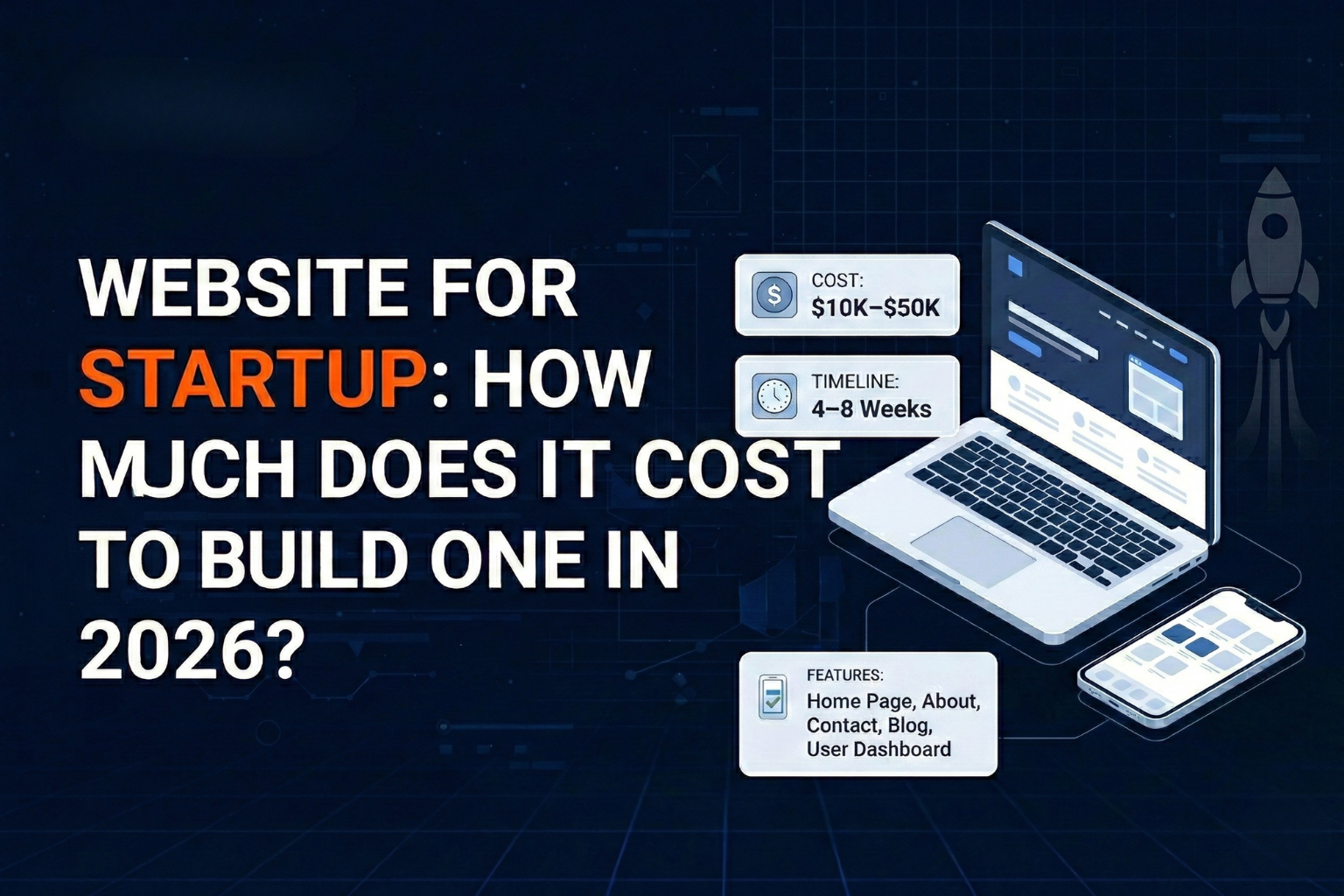
Website for Startup: How Much Does It Cost to Build One in 2026?
Your website is more than just a digital business card if you're a tech founder who wants to quickly prove the value of your startup. It's your first MVP. It helps you get leads, try out your idea in the real world, and gain investors' trust before your runway starts to get shorter.
In 2026, with India's startup ecosystem booming (over 100K registered startups via Startup India), the cost of building a startup website ranges from ₹15,000 for a simple landing page to ₹15 lakhs+ for a scalable SaaS platform. The difference? Strategy.
This guide, written from a seed-stage founder's lens, breaks down every cost factor, compares platforms like WordPress, Flutter Web, Next.js, Webflow, and Bubble, shares real-world savings hacks, and ends with a direct path to launch via VoxturrLabs.
Smart platform choices can cut costs by 40–60% and increase conversions by 60% through mobile-first design, whether you're starting from scratch or running a well-known SaaS for users all over the world. Let's get started.
Why Your Startup Needs a Website in 2026 And Why Waitlists Convert Best
In the era of AI-driven no-code tools and serverless hosting, skipping a proper website means missing 70% of organic traffic that turns curious visitors into committed beta users. Founders like those at Zomato started with deceptively simple landing pages collecting emails and building waitlists, hitting 10,000+ signups well before their full product launched.
Your startup website needs to get three things right. Credibility is established through a clean, professional UI; conversion is achieved with frictionless waitlists or lead capture forms; and scalability is ensured by an SEO architecture that earns traffic for the "Keywords" you wanted to target when someone searches for them.
There is evidence to support this. When compared to startups that rely solely on social media or word-of-mouth, those that have optimised their websites see a twofold increase in investor interest and a threefold acceleration in the acquisition of users. If you pursue feature perfection too early on, however, you run the risk of your costs spiralling out of control.
When it comes to the pre-seed stage, what is the most appropriate course of action to take? Build a ₹50K MVP. Additionally, a compelling hero section, an email capture form, an embedding of a demo video, and an optional Stripe pre-order button are all included in this. This method eliminates the need to pay US agency rates of more than $20,000 in order to validate real demand.
Pro Tip: Install Google Analytics and Hotjar from day one. Track your mobile bounce rate and aim to keep it under 40%. If visitors are leaving fast, your messaging or load speed is the problem, not the product.
Startup Website Cost Breakdown by Stage: Pre-Seed to Series A
When it comes to building for the stage they want to be at, rather than the stage they are actually in, the most common mistake that founders make is. Your current validation requirements must be met by the costs.
Stage-by-stage investment scaling:
Stage 1 Pre-Seed Landing Page (₹15,000–₹50,000 | 3–7 Days)
One hypothesis you're testing is whether anyone is worried enough to change their email. Your website requires a domain name, which can be purchased from GoDaddy or Namecheap for ₹800 per year; shared hosting of ₹3,000 per year from Hostinger or Bluehost; a no-code builder; and a lead-capture form that is operational. And that's it.
Success metric: 500+ waitlist signups before you write a single line of product code.
Stage 2 Seed SaaS Site (₹1–3 Lakhs | 2–6 Weeks)
After you have established that there is a demand for your product or service, it is time to establish credibility and collect qualified leads. A custom user interface and user experience design, user authentication (Firebase is an excellent choice for this), API integrations (Stripe for payments and Zapier for automation), and foundational SEO meta tags, sitemap, and schema markup are all required at this stage.
Success metric: 1,000 monthly active users and a 20% email-to-signup conversion rate.
Stage 3 Series A Platform (₹5–15 Lakhs+ | 8–16 Weeks)
The momentum is on your side. Build now with scale in mind. This entails a full-stack architecture that makes use of Next.js or Flutter Web, integrated payment flows, a customer relationship management dashboard for your team, and an A/B testing infrastructure to optimise each and every touchpoint in the funnel.
Success metric: 10,000 users and ₹8–10 lakh in Monthly Recurring Revenue (MRR).
The India Advantage
As opposed to the US agency rates of $100–$250 per hour, local developers charge between ₹1,000 and ₹3,000 per hour. Especially when you collaborate with specialised agencies that are focused on startups, this represents a three- to fivefold reduction in costs without compromising quality.
Voxturr Labs provides website packages for seed-stage SaaS startups starting at ₹1.5 lakhs. These packages offer 30 days of post-launch support.
Don't forget about ongoing costs that aren't obvious: Hosting costs between ₹3,000 and ₹10,000 a year, domain renewal costs ₹1,000 a year, regular maintenance costs 10–15% of your build cost each year, and SEO tools like Mangools or Ahrefs cost between ₹3,000 and ₹5,000 a month. Add 20% to your total budget as a safety net.
Real founder example: A Pune-based fintech founder spent ₹28,000 on a Webflow MVP, captured 2,000 emails in 45 days, then iterated to a ₹2.5 lakh Next.js platform. They hit ROI by month two.
What Drives Startup Website Costs Up by 200%?
Over 70% of website cost overruns come from a single source: scope creep. Features get added mid-build, designs get revised five times, and suddenly your ₹50K project is at ₹1.5 lakhs. Here's what actually drives your final bill and how to control each lever.
Features & Functionality
A basic site with a hero section, CTA, testimonials, and a contact form runs ₹10,000–₹20,000. Add user authentication, a personalised dashboard, and real-time chat, and you're looking at an additional ₹1–2 lakh.
Rule of thumb: Defer anything that doesn't directly drive signups or revenue. Consider opting for a free Typeform instead of the chatbot.
Design & UX
Using a pre-built template costs ₹5,000–₹15,000. A fully custom Figma-to-code design runs ₹50,000+. The right choice depends on your brand strategy. For most pre-seed startups, a well-configured premium template is indistinguishable from custom work.
One thing that's never optional: mobile responsiveness. More than 55% of startup website traffic comes from mobile devices, and mobile-optimised designs convert at 60% higher rates than their desktop-only counterparts.
Team Structure
Your choice of who builds your site matters as much as what you build:
-
Freelancers (via Upwork or Toptal): ₹50,000–₹1.5 lakhs. While freelancers offer flexibility, they also carry the risk of delays, scope disputes, and inconsistent quality.
-
Specialized Agencies (like Voxturr Labs): ₹1–₹5 lakhs. This package includes project management, QA testing, deployment, and often post-launch support. For most founders, this option represents the best return on investment.
-
In-house team: ₹3–₹6 lakhs in salaries alone, and significantly slower for early MVPs. Best reserved for post-seed when your product is validated.
Performance & SEO
Core Web Vitals compliance, keeping your page load under 2.5 seconds, adds approximately ₹20,000 to your build cost. But it pays back fast. Google's ranking algorithms now heavily weight page speed, and a slow site directly reduces your organic visibility.
On-page SEO setup via tools like Yoast (for WordPress) or built-in Next.js metadata is non-negotiable if you're targeting search traffic for keywords like "startup website costs in India."
Integrations
Stripe payment setup costs around ₹10,000. Google Analytics is free but requires proper event configuration. HubSpot CRM integration runs ₹15,000–₹20,000 for custom work. Each integration adds time and cost; prioritise only what you'll actually need at the launch.
The Scalability Trap
Ignoring scalability during the build stage is the biggest hidden cost that founders miss. A ₹30,000 WordPress site on shared hosting will break down if 5,000 people try to use it at the same time. Moving to a serverless architecture like Vercel can cost ₹1.5 to ₹2 lakhs and push back the timeline for your product by months. It's almost always better to build on serverless from the start.
WordPress vs Next.js vs Flutter Web vs Webflow: Best Startup Website Platform 2026?
Your technology stack makes up 50% of your total cost and 80% of how quickly you can launch. If you make the wrong choice at the start, you'll have to pay a lot to move later. Here's a clear look at 2026.
WordPress (₹20,000–₹80,000 | 1–2 Weeks)
The CMS that people use the most. You can make a professional-looking website surprisingly quickly with Elementor's free tier and a ₹2,000 premium theme. Plugins can do everything from SEO (Yoast) to forms (Gravity Forms) to online shopping (WooCommerce).
Best for: blogs, media companies, portfolios, and service businesses that have a lot of content.
Watch out for: Security patches eat into your maintenance time, performance degrades at scale without significant optimization, and plugin conflicts are a real headache. Avoid WordPress for SaaS products beyond the pre-seed validation phase.
Webflow / No-Code (₹10,000–₹50,000 | 3–7 Days)
Webflow's visual drag-and-drop editor, founders who aren't tech-savvy can make beautiful, fully responsive websites without writing any code. The CMS plan includes hosting (about ₹1,000 per month), built-in animations, and clean, optimised HTML and CSS.
Best for: Non-technical founders who need a polished site fast for validation. Perfect for pre-seed.
Watch out for: Limited backend logic capability, and the Pro plan runs ₹20,000+/year. If your product has complex user flows or database requirements, you'll outgrow Webflow quickly.
Power move: Combine Webflow with Memberstack for user authentication full MVP with logins for around ₹25,000 total. That's 4x faster than going custom.
Next.js / React (₹1.5–₹4 Lakhs | 3–6 Weeks)
Next.js is the clear choice for startups where SEO and dynamic content are central to growth. Server-Side Rendering (SSR) makes your pages indexable by Google from day one. Incremental Static Regeneration (ISR) means your blog and product pages update without full rebuilds. Deploy on Vercel's free tier and scale seamlessly.
Best for: SaaS products with user dashboards, blogs, marketing sites with dynamic content, and any startup where organic search is a key acquisition channel.
Watch out for: You need JavaScript expertise on your team or in your agency. Steeper learning curve for non-technical founders evaluating technical partners.
Flutter Web (₹1–₹3 Lakhs | 4–8 Weeks)
Google's open-source framework compiles Dart code to native WebAssembly, which gives you animations at 58–60 FPS instead of React's usual 45 FPS. The real superpower is that 70% of the code can be used on the web, iOS, and Android. Build it once and use it everywhere.
According to data from Matebiz, the average cost of a Flutter Web MVP in India is around ₹1.2 lakhs. This includes responsive design, Firebase authentication, and smooth animations that load in less than 1.5 seconds.
Best for: Startups with ambitions to launch mobile apps alongside their web product. If you're planning an iOS/Android app within 12 months, Flutter Web saves you ₹3+ lakhs versus maintaining separate React Native and web codebases.
Watch out for: Initial JavaScript bundle sizes can hit 1–2MB. Work with your dev team to optimize via tree-shaking; a well-optimized Flutter Web bundle compresses to under 500KB.
Voxturr Labs Flutter Web MVPs start at ₹1.8 lakhs, including Progressive Web App (PWA) support for offline functionality.
Bubble Full-Stack No-Code (₹30,000–₹1.5 Lakhs | 1–4 Weeks)
You can use Bubble to make database-driven apps that look like marketplaces, booking platforms, or two-sided networks. For non-technical founders, the fastest way to get a working product is to use native Stripe integration, visual workflow builders, and a real database.
Best for: MVPs that require database logic marketplaces, directories, and SaaS tools with complex user flows.
Watch out for: Vendor lock-in is real and painful. If you need to migrate off Bubble, you're essentially rebuilding from scratch. Scaling costs jump fast: from $25/month to $500+/month as your user base grows.
Platform Decision Framework
The smartest path for most startups: validate on Webflow (₹15,000, 3–7 days), then scale to Flutter Web or Next.js once you have 500+ users and know what features actually matter. Avoid WordPress beyond pre-seed. Avoid Bubble unless your MVP is explicitly database-driven.
How to Cut Startup Website Costs by 50%: Proven Strategies That Work
Every rupee saved at the pre-seed stage extends your runway. Here are the strategies that actually work not theoretical, but tested by founders in India's startup ecosystem.
1. Validate Before You Build
Use Carrd.co (₹1,000/year) or a basic Webflow page to test your headline, value proposition, and call-to-action before you commission a full build. Run 500 visitors to a landing page. If you can't get 10% to sign up, fix your messaging not your tech stack.
2. Leverage Open-Source Everything
Flutter, React, Tailwind CSS, and Supabase are all completely free. Self-host your codebase on GitHub. Use Supabase's generous free tier for your database. These tools power production apps at companies far larger than most Indian startups.
3. Outsource to India Specifically
The global rate arbitrage is real. Firms in Pimpri-Chinchwad like Voxturr Labs charge $20–$40/hour with English-fluent project managers and senior engineers. Compare that to $150–$250/hour for equivalent US talent. For a 200-hour project, that's a ₹18–₹25 lakh difference.
4. Go Serverless from Day One
Vercel and Netlify both offer free tiers covering up to 100GB of bandwidth. Pair with Supabase (free up to 500MB database) and you can run a production startup site for ₹0/month until you're generating real revenue. Only pay when you scale.
5. Ruthlessly Prioritize Your MVP Loop
Your launch site needs exactly three things: authentication, payments, and analytics. That's your core loop. Defer everything else. Don't build a blog use Substack. Don't build a help center use Notion. Don't build an analytics dashboard use Google Analytics + Mixpanel free tiers. Every deferred feature is runway saved.
6. Use AI Tools to Cut Dev Time by 30%
Framer AI generates landing page designs from a text prompt for around ₹2,000. GitHub Copilot cuts developer coding time by 25–35% on average meaning a 6-week project becomes a 4-week project. At ₹2,000/hour for a senior developer, that's meaningful savings.
7. Vet Freelancers With Paid Test Tasks
Before committing ₹1.5 lakhs to a freelancer on Upwork, assign a ₹10,000 paid test task a single component, a landing section, or a simple API integration. You'll learn everything you need to know about their communication style, code quality, and reliability before the real engagement begins.
Real Case Study: Pune SaaS Founder
A SaaS founder (anonymous, Pimpri-Chinchwad) came to Voxturr Labs with a US agency quote of $22,000. Voxturr built their Flutter Web MVP in 6 weeks for ₹1.2 lakhs including waitlist functionality, Stripe integration, and full analytics setup. Month 1 result: 1,000 users. The same codebase scaled to their Series A platform for an additional ₹4 lakhs, with zero architectural rewrites.
India vs. Global Cost Comparison
|
Metric |
India |
US/EU |
|
Basic Landing Page |
₹15,000–₹50,000 |
$2,500–$10,000 |
|
SaaS MVP |
₹1–₹5 Lakhs |
$20,000–$100,000 |
|
Senior Developer Rate |
₹1,000–₹3,000/hr |
$100–$250/hr |
|
Post-Launch Support |
Included (30 days) |
$150–$300/hr |
5 Startup Website Mistakes That Burn Your Budget
Learning from others' mistakes is free. Here are the most costly decisions founders make when building their first startup website.
Mistake 1: Building features nobody uses. The average startup launches with 60% of features that their first 100 users never touch. Build the minimum that proves your core hypothesis. Interview 10 potential users before writing a single spec.
Mistake 2: Choosing the wrong platform for their growth stage. A Bubble site that costs ₹50,000 to build will cost ₹3 lakhs to migrate off when you need custom functionality at 5,000 users. Platform decisions have compounding consequences.
Mistake 3: Skipping mobile optimization. In India, mobile internet usage exceeds 70% of all web traffic. A site that isn't mobile-first isn't a startup website it's a liability. Every platform mentioned in this guide can produce mobile-responsive output, but you need to explicitly design for mobile, not just accommodate it.
Mistake 4: Delaying SEO to "later." SEO takes 3–6 months to compound. Founders who launch without basic SEO infrastructure and plan to "add it later" are giving their competitors a 6-month head start on organic traffic they can never fully recover.
Mistake 5: Underestimating maintenance costs. A website isn't a one-time project it's a living product. Security patches, content updates, performance optimization, and feature additions are ongoing. Budget 10–15% of your build cost annually for maintenance.
What High-Converting Startup Websites Always Get Right
After analyzing 100+ startup launches at Voxturr Labs, clear patterns emerge in what separates high-converting startup sites from expensive digital brochures.
Clear, singular value proposition above the fold. The best startup websites communicate their core promise in a single sentence within 3 seconds of landing. No jargon, no buzzwords just a direct statement of who you help and how.
Social proof early. Logos of recognizable customers, advisor names, or media mentions positioned in the first scroll. If you're pre-launch, use quotes from beta users or waitlist members.
Frictionless lead capture. The signup or waitlist form should require nothing beyond an email address. Every additional field you add reduces conversion by 10–15%. You can qualify leads later.
Demo video or animated product preview. Startups with embedded product demos convert at 2–3x the rate of text-only landing pages. A 60-second Loom video recorded on a ₹0 budget outperforms a beautifully designed feature grid.
Speed. In India's mobile-first market, every additional second of load time reduces conversions by 7%. Your site must be fast not just acceptable, but genuinely fast. This means optimized images (WebP format), minimal JavaScript, and a CDN.
Conclusion
This guide's frameworks, cost benchmarks, and platform comparisons are only useful if you follow through on them. Working with a team that has already resolved the precise issues your startup will encounter is also the quickest course of action.
Across a wide range of industries, including SaaS, solar energy, luxury e-commerce, fitness, nutrition, and insurance education, Voxturr Labs has assisted more than 500 international businesses in digitising and expanding. Voxturr created a conversion-driven website for Rebiz that transformed features into revenue conversations when they needed to explain complex SaaS value to enterprise buyers without drowning them in technical jargon. Voxturr automated their entire lead capture system, so the website did the selling for Onyx Gyms when they wanted to stop manually chasing leads across multiple locations. Voxturr completely redesigned Objective Nutrients' e-commerce experience as a headless, high-performance shopfront when they were losing conversions to a sluggish, rigid legacy platform. Every time, the same pattern emerges: a genuine business issue, a targeted digital solution, and quantifiable outcomes.
When your startup website needs to do more than just look good, that variety of experience from a solar energy company like Yellowlite needing enterprise-scale infrastructure to Vajra Jewellery needing a premium e-commerce presence that earns trust for high-value purchases to Health Insurance CE needing a unified platform for learning and commerce is exactly what sets you apart. It must function.


Gaurav Lakhani is the founder and CEO of Voxturrlabs. With a proven track record of conceptualizing and architecting 100+ user-centric and scalable solutions for startups and enterprises, he brings a deep understanding of both technical and user experience aspects. Gaurav's ability to build enterprise-grade technology solutions has garnered the trust of over 30 Fortune 500 companies, including Siemens, 3M, P&G, and Hershey's. Gaurav is an early adopter of new technology, a passionate technology enthusiast, and an investor in AI and IoT startups.

Ready for a Next-Level of Enterprise Growth?
Let's discuss your requirements