Flutter vs Swift: Cross-Platform vs Native iOS Development
A Complete Business Guide to Choosing the Right Framework for Your iOS App
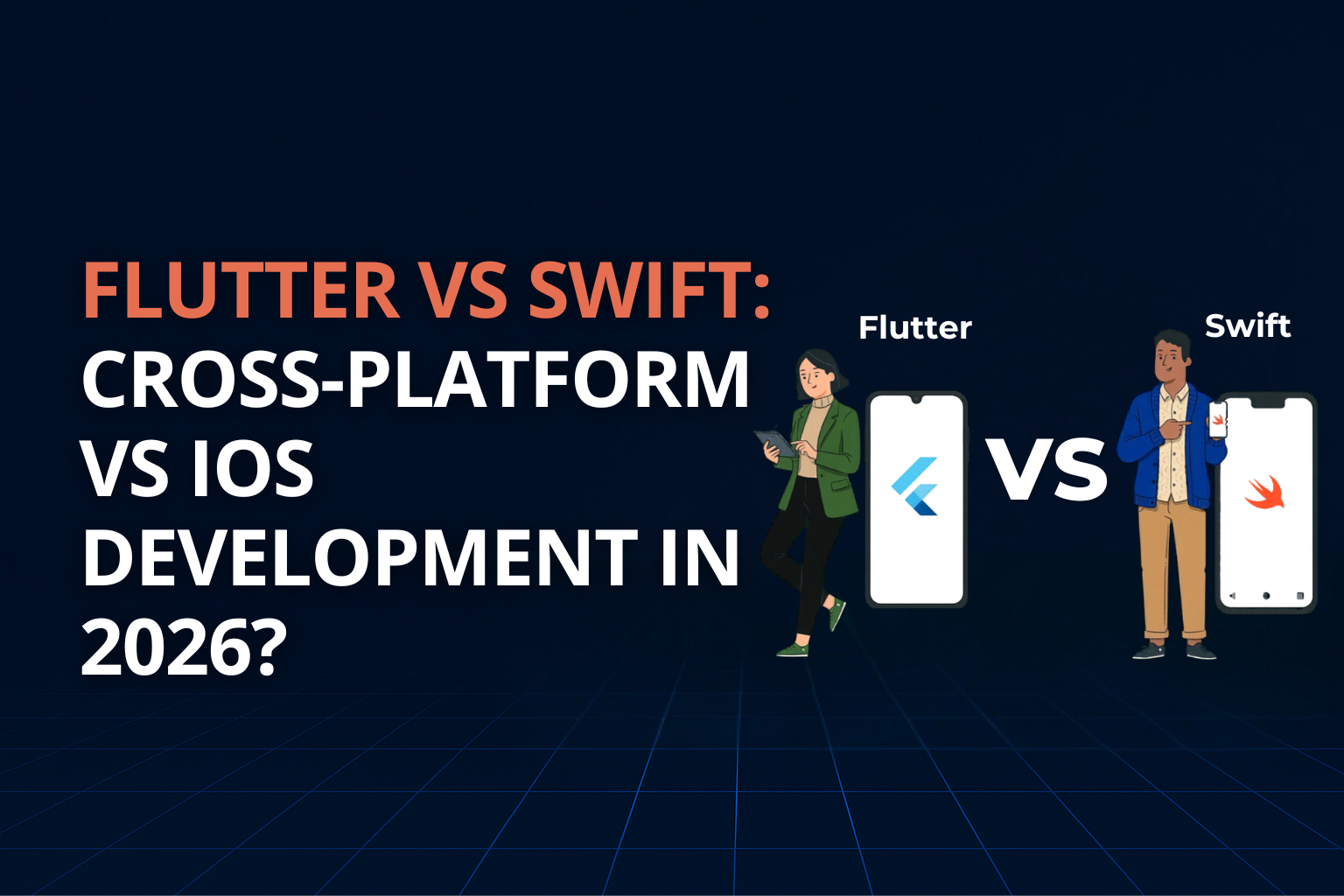
Flutter vs Swift: Cross-Platform vs Native iOS Development in 2025
When your business is ready to build an iOS application, one of the very first decisions you will face is the choice between Flutter vs Swift. Both are powerful, both are widely adopted, and both are backed by tech giants, namely Google and Apple respectively. But choosing between them is not simply a technical question. It is a strategic business decision that directly impacts your development cost, time to market, long-term maintenance, and the quality of your user experience. Flutter is Google's cross-platform framework that lets you build for iOS, Android, web, and desktop from a single codebase. Swift is Apple's native programming language built exclusively for iOS, macOS, watchOS, and tvOS. In this blog, we break down every factor that matters, including performance, cost, development speed, and real-world use cases, so you can confidently decide which is the right choice for your next iOS app project.
Understanding Flutter vs Swift: The Core Difference
Before diving into a side-by-side comparison, it is important to understand what each technology actually is and what problem it solves. Flutter and Swift are fundamentally different in their approach to building iOS applications, and that difference shapes every decision downstream.
What is Flutter?
Flutter is Google's open-source UI development framework, released in 2017 and built on the Dart programming language. Its defining feature is the ability to write one codebase and deploy it across iOS, Android, web, Windows, macOS, and Linux simultaneously. Flutter renders its own UI using Google's Impeller rendering engine, meaning it does not rely on the operating system to draw buttons, text, or animations. This gives Flutter pixel-perfect consistency across all platforms. According to a 2024 Statista report, Flutter is now used by 46% of global developers, making it the most widely adopted cross-platform framework in the world.
What is Swift?
Swift is Apple's native programming language, introduced in 2014 as a modern replacement for Objective-C. It is purpose-built for the Apple ecosystem and integrates directly with iOS frameworks such as SwiftUI, UIKit, ARKit, CoreML, HealthKit, and Core Bluetooth. Because Swift compiles directly to native ARM machine code with no intermediary layer or rendering bridge, it delivers the highest possible performance on iOS devices. Swift is the go-to choice for 46% of developers building exclusively within the Apple ecosystem who prioritize performance, hardware access, and deep iOS integration above all else.
Flutter vs Swift: Side-by-Side Comparison
Here is a complete side-by-side comparison across the factors that matter most to business owners and product teams when deciding between Flutter vs Swift for iOS app development:
|
Factor |
Flutter |
Swift |
|
Language |
Dart (Google) |
Swift (Apple) |
|
Platform Support |
iOS, Android, Web, Desktop, all in one |
iOS, macOS, watchOS, tvOS only |
|
Performance |
Near-native via Impeller engine |
Full native, compiles to ARM code |
|
Development Speed |
Fast: Hot Reload, single codebase |
Moderate: Xcode-only workflow |
|
Development Cost |
Lower: one team for all platforms |
Higher: separate team for each OS |
|
UI Consistency |
Pixel-perfect across all platforms |
Platform-specific native UI only |
|
iOS API Access |
Partial: via platform channels |
Full: direct access to all APIs |
|
Hardware Access |
Limited for advanced features |
Full: ARKit, CoreML, Bluetooth, etc. |
|
App Size |
Slightly larger due to engine bundle |
Smaller: no rendering engine overhead |
|
Learning Curve |
Moderate: Dart is easy to learn |
Moderate: Swift syntax is clean |
|
Best For |
Startups, MVPs, cross-platform products |
iOS-only apps needing top performance |
|
Backed By |
|
Apple |
Flutter vs Swift: Performance Comparison
Performance is the most debated aspect of the Flutter vs Swift conversation. Here is the honest picture. Swift compiles directly to native ARM machine code with zero intermediary layers. This means it delivers the fastest possible execution speed and the smoothest animations for iOS-specific apps. For use cases involving augmented reality, real-time data processing, machine learning inference, or complex graphical computation, Swift's native performance is genuinely superior. Flutter, on the other hand, uses Google's Impeller rendering engine to draw every pixel on screen itself, bypassing the OS rendering layer entirely. This gives Flutter full control over visual output and frame consistency across platforms. For the vast majority of business applications, including e-commerce apps, SaaS dashboards, B2B tools, healthcare portals, and fintech apps, Flutter's performance is effectively indistinguishable from native Swift to the end user. The performance gap only becomes meaningful in edge cases involving deep hardware integration or extreme computational loads.
Bottom Line: For 90% of business apps, Flutter's performance is sufficient and delivers a smooth native-like experience. Choose Swift only if your app requires deep hardware integration or real-time computation at the system level.
Flutter vs Swift: Development Cost and Timeline
Cost and timeline are where Flutter vs Swift most directly impacts your business decision. When you build with Swift for iOS only, you are committing to building a separate codebase for Android later, which effectively doubles your development budget and your time to market. Flutter eliminates this problem entirely by allowing you to build for both iOS and Android simultaneously from one codebase. Industry data consistently shows that native development with Swift costs 1.8x to 2x more than cross-platform Flutter development when targeting both iOS and Android. Here is how the two options compare across different business scenarios:
-
Startup building first product: Flutter saves 40 to 60% of development cost vs Swift
-
Enterprise app targeting iOS-only: Swift is justified when performance is the top priority
-
MVP launch in under 12 weeks: Flutter's Hot Reload and single codebase make this far more achievable
-
SaaS product needing web and mobile: Flutter is the clear winner as Swift cannot cover web
-
App needing ARKit or Core ML: Swift is necessary for deep Apple framework integration
-
Long-term maintenance budget: Flutter is cheaper, with one codebase to update vs two
When to Choose Flutter and When to Choose Swift
The Flutter vs Swift decision ultimately comes down to your app's specific requirements, your target audience, your budget, and your long-term roadmap. There is no universally correct answer, but there is a right answer for your specific situation. Here is a clear framework to guide your decision:
Choose Flutter When:
-
You need your app on both iOS and Android, now or in the future
-
You are building an MVP or first version of your product and speed to market matters
-
Your budget requires a single team to cover all platforms
-
Your app does not rely on advanced iOS-specific hardware features like ARKit or CoreBluetooth
-
You are building a SaaS tool, B2B dashboard, e-commerce app, or EdTech platform
-
You want a highly customized, brand-consistent UI that looks identical across all devices
If your project fits any of the above criteria, explore our Flutter App Development Services to see how VoxturrLabs can help you build a high-performance cross-platform application tailored to your business needs.
Choose Swift When:
-
You are building exclusively for iPhone, iPad, Apple Watch, or macOS
-
Your app requires direct access to ARKit, Core ML, HealthKit, or Apple Pay
-
Performance is non-negotiable: real-time processing, AR, or complex graphics are core features
-
You are targeting a premium Apple-only audience and native iOS polish is a priority
-
Budget is not the primary constraint and long-term iOS exclusivity is your strategy
-
You are building a consumer-facing app where every animation and transition must feel flawlessly native
Conclusion
The Flutter vs Swift debate does not have a single winner. It has a right answer for your specific situation. Flutter is the smarter choice for most businesses in 2026 because it delivers near-native performance, dramatically reduces development cost, and lets you reach iOS, Android, and web audiences from a single codebase. Swift remains the superior choice for apps that demand the absolute highest level of iOS performance and deep integration with Apple's native hardware and software ecosystem. If you are a startup, a growing business, or a team building a SaaS product, Flutter vs Swift almost always tips in Flutter's favour from a cost and speed perspective. If you are building a precision healthcare app, an AR-powered experience, or an enterprise tool that lives exclusively in the Apple ecosystem, Swift is your strongest foundation. The most important step is to evaluate your specific requirements, not just today but for the next three years, and choose the framework that best serves your users, your team, and your business goals.
Ready to get started? Partner with VoxturrLabs and take advantage of our expert Flutter App Development Services to bring your cross-platform app idea to life with speed, precision, and a team that understands your business goals from day one.
Frequently Asked Questions (FAQs)
Q1. Is Flutter better than Swift for iOS development?
Flutter is better when you need cross-platform reach and faster development at lower cost. Swift is better for iOS-only apps requiring maximum native performance. For most business apps, Flutter delivers a near-native experience that meets user expectations perfectly.
Q2. Can Flutter match Swift's performance on iOS?
For 90% of business applications, Flutter's performance via the Impeller engine is effectively indistinguishable from Swift. The gap only matters in edge cases involving real-time computation, ARKit, or deep hardware access that Flutter's platform channels cannot fully replicate.
Q3. Is Flutter cheaper to develop than Swift for iOS apps?
Yes. Flutter is 40 to 60% more cost-effective than Swift when targeting both iOS and Android, because one team builds one codebase for both platforms. Swift requires separate iOS and Android teams, effectively doubling your development and maintenance spend.
Q4. Can I use Flutter and Swift together?
Yes. Flutter allows you to integrate Swift code using platform channels to access native iOS APIs that Flutter does not support directly. This hybrid approach lets you use Flutter for the UI and Swift for specific hardware or system-level functionality when needed.
Q5. Which is Better for Startups Flutter or Swift?
Flutter is almost always the better choice for startups. It reduces development time, lowers costs, and allows you to reach both iOS and Android users from one codebase, which provides all critical advantages when speed to market and budget efficiency are the primary priorities.
Q6. Which companies use Flutter vs Swift for their apps?
Flutter powers Google Pay, eBay Motors, BMW, Alibaba, and Reflectly. Swift is used by Apple, Instagram, Airbnb, and LinkedIn for their native iOS experiences. The choice reflects their platform strategy, whether multi-platform or iOS-exclusive focus, respectively.


Gaurav Lakhani is the founder and CEO of Voxturrlabs. With a proven track record of conceptualizing and architecting 100+ user-centric and scalable solutions for startups and enterprises, he brings a deep understanding of both technical and user experience aspects. Gaurav's ability to build enterprise-grade technology solutions has garnered the trust of over 30 Fortune 500 companies, including Siemens, 3M, P&G, and Hershey's. Gaurav is an early adopter of new technology, a passionate technology enthusiast, and an investor in AI and IoT startups.

Ready for a Next-Level of Enterprise Growth?
Let's discuss your requirements
You May Also Like
App Development
Native vs Hybrid vs Cross Platform App Development: Which Should You Choose in 2026?
A veteran developer's honest guide to choosing between native, hybrid, and cross-platform mobile app development based on real-world constraints, not marketing hype.
 24 min read

App Development
App Development Charges in 2025
Discover the real App Development Charges in 2025. Learn stage-by-stage costs, tips to save, and how VoxturrLabs helps you build smarter. Book a free consult now!
19 min read
App Development
Flutter App Development Cost in 2025: Complete Breakdown
2025 guide to Flutter app development cost. See ranges from $10k to $200k+, key cost drivers, complexity tiers, region wise rates, and a simple estimate cost breakdown,
7 min read
App Development
Kotlin vs Flutter 2025: Which Is Best for Your Mobile App?
A practical comparison guide for product leaders, founders, and mobile teams choosing their cross-platform stack
16 min read

App Development
How to Choose the Right Flutter App Development Services Partner
A practical guide for CTOs and founders to vet Flutter development partners. Compare costs, evaluate portfolios, and avoid common hiring mistakes.
11 min read

App Development
App Development Cost Breakdown “What You’re Paying For”
When you consider kick starting or expanding your business through a mobile app, the first question you ask yourself is, “how much will the app development cost?” This is a pressing question for many, especially when you’re looking to expand your base as
12 min read

App Development
iOS App Development – Learn to Build Your First High-Performing Business App
In today’s digital age, mobile apps have become integral to our daily lives. With the growing popularity of iOS devices. The Apple App Store has 1.96 million apps available for download. iOS app development is an almost necessary business move for startup
9 min read